
Frequently asked questions
Straight answers about One-Day TMS, medication management, and traveling to Steamboat Springs for care.
One-Day TMS
We combine brain stimulation, medication management, and therapy. What we recommend comes from your evaluation, not this page.
Why haven't I heard as much about One-Day TMS?
Traditional TMS involves 36 separate visits over six weeks. Single-day accelerated TMS is a cutting-edge protocol built on recent neuroplasticity research. Because it is an advanced, out-of-network protocol, it offers unmatched time efficiency for patients with busy schedules.
Is One-Day TMS FDA-approved?
Standard TMS devices are FDA-cleared for conditions like depression and anxiety. Delivering a full 20-session treatment course in a single accelerated day is an off-label clinical protocol based on recent neuroplasticity research.
Can I work during the treatment day?
By the end of the day, you will likely feel tired, like you took an exam or studied in the library all day. Plenty of people work, read, or listen to music between sessions. You will be able to drive yourself home after treatment. We just ask that you don't leave between sessions because being on schedule is important.
How likely is TMS to work for me?
It varies, and we won't pretend to know.
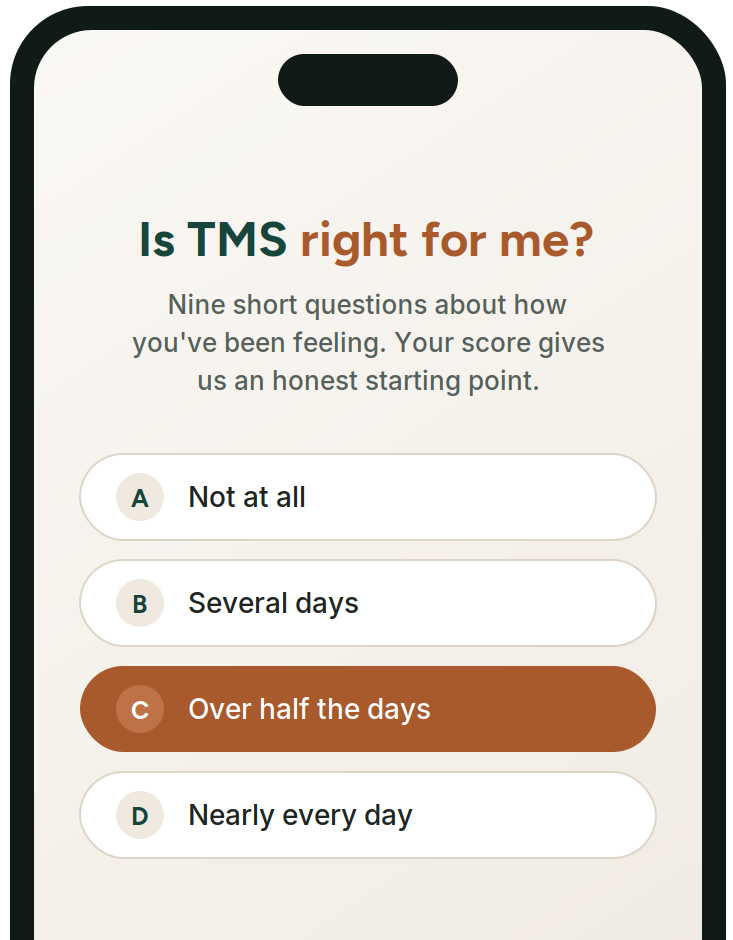
Learn More here: Is TMS right for me ?
What if TMS isn't the right treatment for me?
Then we'll say so. Medication management and psychotherapy are available here too, and for some people, that's the better place to start.
How TMS Works
A full course of transcranial magnetic stimulation delivered in a single visit, rather than daily sessions over six to eight weeks.
Is TMS the same as Electroconvulsive Therapy (ECT)?
No. ECT induces a seizure under general anesthesia in a hospital setting. TMS is performed in a comfortable clinic chair without anesthesia or sedation, does not induce seizures, and has no adverse effects on memory. It is common to confuse the two, but TMS is entirely different.
Does treatment hurt?
TMS is not painful, though it produces a tapping sensation on the scalp accompanied by a clicking sound. Most patients adjust quickly within the first few minutes, and our primary focus is tailoring settings to keep you completely comfortable.
What are the side effects and risks?
The most common side effects are temporary scalp tenderness or a mild headache, both of which are easily managed with over-the-counter pain relievers and fade quickly. Seizure risk is extremely rare (less than 0.1%)—comparable to or lower than the risk associated with many common daily antidepressant medications.
Who is not a candidate for TMS?
TMS is not suitable for individuals with non-removable magnetic metal implants in or near the head (such as aneurysm clips, deep brain stimulators, or metallic implants, excluding standard dental fillings and braces) or those with an uncontrolled seizure disorder.
Can I drive home after my treatment session?
Yes. Because TMS requires no sedation, anesthesia, or systemic medication that affects motor skills, you can safely drive yourself to and from the clinic and immediately return to your normal routine.
How long before I notice results?
Response durability varies. Many patients experience lasting relief for months to years. For those who benefit from periodic maintenance, follow-up booster sessions are available and are typically shorter than the initial full-day protocol.
Will I need ongoing maintenance treatments?
Response durability varies. Many patients experience lasting relief for months to years. For those who benefit from periodic maintenance, follow-up booster sessions are available and are typically shorter than the initial full-day protocol.
Can I stop taking my psychiatric medications?
Please do not stop taking medications abruptly. You will continue taking your current medications throughout your TMS treatment. Once treatment is complete, your provider will work with you on your long-term medication goals, which may include safely tapering or reducing doses over time.
Medication Management
Unhurried psychiatric prescribing, a 60-minute first evaluation and one provider who knows your history.
Do you take insurance?
No. Rising Psychiatry does not bill to private insurance, medicaid, or medicare. We can provide itemized superbills for medication management visits, which many insurers reimburse at out-of-network rates.
Can I do appointments by video?
Yes. Telehealth visits are available for residents located in Colorado. For patients seeking accelerated TMS who live outside of Colorado, we can conduct initial virtual consultations prior to your travel to our Colorado office for treatment.
Do you offer therapy as well?
Yes. We integrate specialized psychotherapy alongside medication management, including Cognitive Behavioral Therapy (CBT) for individuals, CBT for Insomnia (CBT-I), and Exposure and Response Prevention (ERP) for OCD.
How long before I feel a difference from medication?
Most psychiatric medications need four to six weeks at an optimal dose before you can judge their full effect. We will outline clear milestones and early signs of progress to watch for in the meantime.
Can you take over my existing prescriptions?
In most cases, yes. Please bring your current medication list and recent medical records to your initial 60-minute evaluation so we can ensure a safe, seamless transition of care.
What if medication isn't the right answer for me?
Then we will say so plainly. TMS and specialized psychotherapy are available here, and for many individuals, non-pharmacological interventions are a better place to start.
Traveling for Treatment
What to know about coming to Steamboat Springs for your One-Day TMS visit.
Which airport should I fly into?
Yampa Valley Regional Airport (HDN) in Hayden is the closest commercial airport, located just 30 minutes from our clinic. Alternatively, you can fly into Denver International Airport (DEN) and drive or take a mountain shuttle up to Steamboat Springs.
Do I need to stay overnight in Steamboat Springs?
Yes, we strongly recommend staying at least two nights: arriving the day before treatment to rest, and staying the night of treatment to recover. Because you will feel mentally fatigued by evening, heading straight home or taking a late flight is not advised.
Can I coordinate follow-up care with my current doctor or therapist?
Yes. We prioritize collaborative care and can share treatment notes and progress updates with your home providers so everyone is aligned on your care plan.
Can I bring a companion with me?
Absolutely. Companions are welcome to relax in our comfortable clinic waiting area or spend the day enjoying Steamboat's skiing, hiking, hot springs, shopping, and dining.
What if I need two days of treatment instead of one?
For certain clinical profiles or preferences, the 20 sessions can be split across two consecutive days (10 sessions per day). We will confirm your exact protocol schedule during your preliminary consultation so you can plan your travel and downtime accordingly.
Still deciding?
Let's
talk it through
A free 15-minute call with Michael - no charge, no pressure, and a straight answer about the right treatment for you.